
Last Updated on September 11, 2026
Sheepshead have a reputation for being some of the most frustrating bait thieves in Florida.
You drop a perfectly good bait beside a bridge piling, feel almost nothing, reel up—and the hook is completely bare.
That’s sheepshead fishing.
The good news is that choosing the right bait and presenting it correctly can dramatically improve your odds. Sheepshead spend much of their time around oyster bars, seawalls, tidal creeks and other hard structure, feeding primarily on crustaceans and small fish. FWC specifically recommends live shrimp, sand fleas and fiddler crabs fished on a small hook near the bottom.
But those aren’t your only choices.
Crabs, shrimp, sand fleas, barnacles and shellfish can all catch sheepshead. The trick is knowing which bait to use, where to put it and how to keep a sheepshead from stealing it before you ever realize you’ve had a bite.
Here’s how I approach bait selection when targeting sheepshead from Florida’s bridges, piers, jetties, docks and shorelines.
What Is the Best Bait for Sheepshead?
If I could bring only one bait specifically for sheepshead, I’d start with fiddler crabs.
But there’s an important distinction between the “best” bait and the most practical bait.
My general ranking is:
| Bait | Best Use |
|---|---|
| Fiddler crabs | Best overall around pilings, docks, bridges and jetties |
| Live shrimp | Best easy-to-find, all-purpose bait |
| Sand fleas | Excellent around jetties, passes and surf-accessible structure |
| Small crabs | Excellent around oyster bars and hard structure |
| Barnacles | Natural bait and especially useful as chum |
| Oyster or clam | Natural food, but soft and more difficult to keep on a hook |
UF/IFAS identifies crabs, barnacles, oysters and clams as preferred sheepshead foods and recommends crustaceans and mollusks when selecting bait.
There’s a simple reason these baits work.
Look at a sheepshead’s mouth.
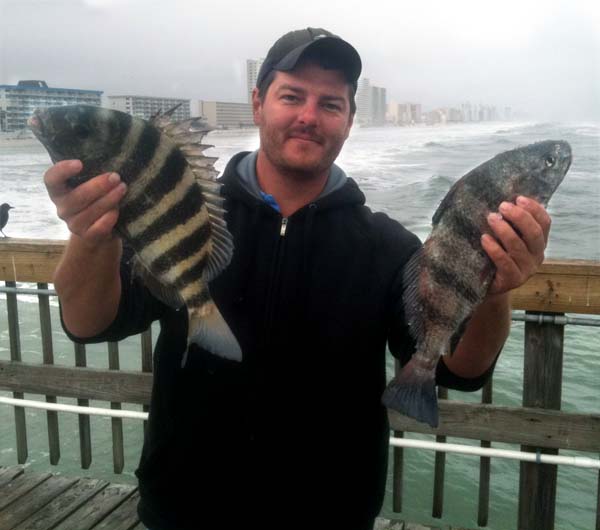
Those unusual incisor-like front teeth and powerful grinders are built for feeding around hard structure. Sheepshead can pick and crush prey that many other inshore fish can’t efficiently eat. UF/IFAS has even documented sheepshead using their incisors to work on shellfish.
So instead of trying to convince a sheepshead to eat something unusual, give it something that resembles what it’s already finding on the structure.
1. Fiddler Crabs: Best Overall Sheepshead Bait
Fiddler crabs would be my first choice when I’m specifically targeting sheepshead.
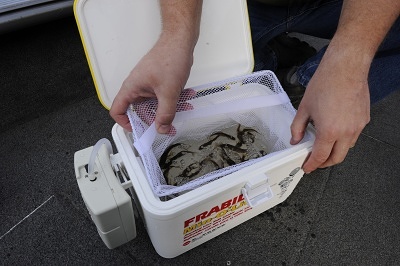
They’re small, natural-looking and closely match the type of crustacean prey sheepshead feed on. Both FWC and UF/IFAS recommend fiddler crabs for sheepshead.
They’re particularly useful around:
- Bridge pilings
- Docks
- Jetties
- Seawalls
- Oyster structure
- Riprap
- Inlets
The biggest advantage of a fiddler crab is its size.
A whole crab creates a compact bait that can be presented on a relatively small hook. That’s exactly what I want when dealing with a fish that’s extremely good at removing bait without getting hooked.
How to Hook a Fiddler Crab
The goal is to secure the crab without destroying it.
Insert the hook through an outer portion of the shell rather than burying the entire hook through the center of the crab.
Keep the hook point exposed.
That’s important with sheepshead.
You don’t want a big wad of bait covering the point when you’re trying to hook a fish that’s capable of quickly crushing the bait and spitting out anything that doesn’t feel right.
Where to Fish Fiddler Crabs
Put the bait right beside the structure.
Not five feet from the piling.
Not ten feet into open water.
If you see barnacles and oysters growing on a bridge piling, that’s effectively a sheepshead feeding station.
Get the crab down beside it.
Let the bait reach the depth where the fish are feeding while maintaining enough contact to detect a bite.
That’s one of the most important lessons in sheepshead fishing:
Good bait in the wrong place isn’t nearly as effective as good bait placed directly in the feeding zone.
2. Live Shrimp: Best All-Around Sheepshead Bait
If fiddler crabs are my favorite dedicated sheepshead bait, shrimp win for convenience.
Walk into almost any Florida coastal bait shop and there’s a good chance you can buy live shrimp.
Shrimp are particularly useful if you’re shore fishing and don’t know exactly what you’re going to encounter.
While targeting sheepshead, the same shrimp might also catch:
- Redfish
- Black drum
- Mangrove snapper
- Flounder
- Snook
That makes shrimp an excellent choice when you’re fishing a bridge, inlet or pier rather than exclusively targeting one species.
Whole Shrimp or Pieces?
Don’t assume bigger bait means bigger sheepshead.
Sometimes a smaller presentation is exactly what you need.
If sheepshead repeatedly steal whole shrimp, experiment with smaller pieces.
A compact chunk can:
- Stay on the hook better
- Make the hook point easier to expose
- Give the fish less bait to grab without touching the hook
When using shrimp specifically for sheepshead, I’m much more concerned with presenting the bait cleanly than making it look impressive.
Where to Fish Shrimp
Shrimp work around almost any sheepshead structure.
Drop them beside:
- Pilings
- Seawalls
- Rocks
- Docks
- Oyster edges
- Jetty rocks
Try to keep the bait close to bottom or beside the structure where fish are feeding.
3. Sand Fleas: An Excellent Sheepshead Bait
Sand fleas—also called mole crabs—are best known as pompano bait, but don’t overlook them for sheepshead.
They’re especially worth considering when you’re fishing:
- Jetties
- Inlets
- Passes
- Beaches near hard structure
- Rock piles
If you’re already surf fishing and have sand fleas available, you don’t necessarily need to find a completely different bait when you move over to nearby rocks or inlet structure.
How to Fish a Sand Flea for Sheepshead
Keep the presentation simple.
Use a small hook and fish the flea close to bottom or alongside structure.
As with fiddler crabs, avoid burying the hook point.
The more compact and clean your bait presentation is, the better.
4. Small Crabs
Fiddler crabs aren’t the only crabs a sheepshead will eat.
Other appropriately sized crabs can make excellent bait.
This makes sense when you consider how sheepshead feed. UF/IFAS identifies crabs as part of their preferred diet, along with barnacles and shellfish.
Small crabs are particularly appealing around:
- Oyster bars
- Mangroves
- Bridge structure
- Rock
- Docks
- Tidal creeks
How to Fish Small Crabs
The same general rule applies:
Small bait. Small hook. Exposed hook point. Tight to structure.
You don’t need to turn a small crab into an elaborate rig.
Let the bait do the work.
If current allows, use as little weight as necessary to get the crab into the feeding zone.
5. Barnacles: Bait and Sheepshead Chum
Barnacles are one of the most interesting sheepshead food sources because you can use them in two ways.
You can use barnacle material as bait, but I think their more interesting application is chumming.
FWC specifically says anglers may scrape barnacles from bridge pilings and allow them to sink through the water to attract sheepshead.
Think about what you’re doing.
A sheepshead living around an old piling is accustomed to feeding on the organisms attached to that structure.
Scrape some barnacles into the water and suddenly pieces of its natural food begin falling down the piling.
That can trigger fish to start feeding.
You can then lower your fiddler crab, shrimp or other bait into the same area.
How to Chum Sheepshead With Barnacles
Find barnacle-covered public structure where collecting them is legal.
Scrape a relatively small amount into the water.
Let it fall naturally beside the structure.
Then drop your bait into the same zone.
Don’t automatically throw huge quantities into the water.
You’re trying to create feeding activity—not fill the fish up.
Important Barnacle Rules
Barnacles and oysters aren’t treated the same under Florida regulations.
Barnacles don’t have a specific size or bag limit, meaning the general recreational limit of up to 100 pounds per person per day can apply with the appropriate recreational saltwater fishing license.
However, do not scrape barnacles from private docks or other private structures without the owner’s permission.
And be absolutely sure you know the difference between a barnacle and an oyster.
Which brings us to bait number six.
6. Oysters and Clams
Sheepshead naturally eat mollusks.
UF/IFAS identifies oysters and clams among their preferred foods.
That makes them legitimate bait.
But they’re not as convenient as fiddler crabs or shrimp.
For one thing, shellfish meat can be soft and difficult to keep on a hook.
More importantly, Florida regulates oyster harvesting.
FWC says oysters are subject to harvesting-area requirements as well as seasons, bag limits and size restrictions. They can only be recreationally harvested from qualifying shellfish harvesting areas that are open.
So don’t walk onto a bridge or seawall and start scraping oysters off the structure because you want sheepshead bait.
If you want to experiment with oyster as bait, buying it is a much simpler option.
Best Sheepshead Bait by Location
Different fishing locations favor slightly different approaches.
Bridges
My first choice: Fiddler crabs
Bridge pilings are almost tailor-made for sheepshead.
Look for older pilings covered in:
- Barnacles
- Oysters
- Marine growth
Lower the bait as close to the piling as possible.
If legal at the location, barnacle chumming can make this even more effective.
Piers
My first choices: Fiddler crabs or shrimp
Fish vertically around pilings rather than automatically casting away from the pier.
The structure underneath your feet may be far more productive than open water 50 yards away.
Jetties
My first choices: Fiddler crabs or sand fleas
Jetties provide abundant hard structure, but snagging becomes a major consideration.
Use enough weight to control your bait without allowing it to tumble endlessly into cracks between rocks.
Seawalls
My first choices: Fiddler crabs or shrimp
Don’t assume you need a long cast.
Sheepshead may be feeding directly against the wall.
A vertical or nearly vertical presentation can be extremely effective.
Docks
My first choice: Fiddler crabs
Target individual pilings.
If one piling doesn’t produce, move to another rather than repeatedly dropping into the exact same spot.
Oyster Bars
My first choice: Small crabs
Fish the edges and nearby deeper water carefully.
Oysters are brutal on fishing line, so be prepared to react quickly when a fish eats.
Best Hook for Sheepshead Bait
Sheepshead are a perfect example of why hook selection should match the bait and target species rather than simply using the same hook for everything.
You want a hook that is:
- Small enough for the bait
- Extremely sharp
- Strong enough to handle a good fish
- Easy to conceal without covering the point
UF/IFAS recommends relatively small hooks for sheepshead and notes that their bite can be very subtle.
Don’t use an enormous hook simply because sheepshead have impressive teeth.
The fish isn’t swallowing a huge baitfish.
You’re often presenting a small crab or piece of shrimp.
Match the hook accordingly.
How Much Weight Should You Use?
As little as conditions allow.
Your sinker has a job:
Get the bait into the feeding zone and keep it under control.
That’s it.
In calm water beside a dock, you may need very little weight.
In deep water with strong current around a bridge, you may need considerably more.
Adjust according to:
- Depth
- Current
- Wind
- Bait size
- Structure
The goal isn’t necessarily to glue the bait to one spot.
You want enough control to know where your bait is and recognize what’s happening to it.
How to Stop Sheepshead From Stealing Your Bait
You won’t stop every sheepshead from stealing bait.
That’s part of the game.
But you can make it harder for them.
Use Smaller Baits
A huge shrimp gives a sheepshead plenty of material to pick apart without touching the hook.
Try downsizing.
Keep the Hook Point Exposed
Don’t bury the hook inside a big ball of bait.
Maintain Contact With the Bait
Too much slack makes subtle bites difficult to detect.
You don’t necessarily want to pull the bait unnaturally, but you do want to know what’s happening.
Watch the Rod Tip
A sheepshead bite isn’t always a dramatic strike.
Sometimes you’ll feel:
tap
Or maybe:
tap…tap
Sometimes the only indication is slightly different pressure.
UF/IFAS specifically notes the light bite and recommends paying attention to small taps.
Check Your Bait
If something feels different, check it.
You might discover that your bait disappeared 30 seconds ago and you’ve been patiently fishing an empty hook.
A Simple Sheepshead Bait Setup
You don’t need a complicated rig.
For a basic vertical presentation around a bridge, dock or seawall, start with:
Main line
↓
Leader
↓
Appropriate weight
↓
Small, sharp hook
↓
Fiddler crab or shrimp
The exact configuration can change depending on current and structure, but the principle stays the same:
Keep it simple and get the bait close to where the fish are feeding.
If you want more detail on rods, reels, line, rigs, seasonal movements and finding fish, see our complete Sheepshead Fishing in Florida guide. FSF’s main guide covers the broader strategy, while this page is intended to help you choose and present the right bait.
Common Sheepshead Bait Mistakes
Fishing Too Far From Structure
This may be the biggest mistake.
If the sheepshead are eating barnacles off a piling, your bait needs to be near the piling.
Using Too Much Bait
More isn’t automatically better.
A compact presentation makes it harder for a sheepshead to steal part of the bait without encountering the hook.
Using a Dull Hook
Sharp hooks matter.
Check the point regularly, especially when fishing around rocks, oysters and pilings.
Using Too Much Weight
Heavy sinkers can make detecting a subtle bite more difficult and can create an unnatural presentation.
Use what you need for the conditions.
Waiting for a Huge Bite
You may never get one.
Learn what the bait feels like when nothing is touching it.
Then pay attention when that feeling changes.
Fishing an Empty Hook
Sheepshead are exceptionally good bait thieves.
When in doubt, check your bait.
So, What Is the Best Bait for Sheepshead?
For dedicated sheepshead fishing, fiddler crabs are my first choice.
They’re small, natural and particularly well suited to fishing around the hard structure where sheepshead feed.
But I’d happily fish any of these six:
- Fiddler crabs
- Live shrimp
- Sand fleas
- Small crabs
- Barnacles
- Oyster or clam
If fiddler crabs aren’t available, don’t let that stop you from fishing.
Buy some live shrimp and go.
The more important lesson is understanding why these baits work.
Sheepshead spend much of their time around hard structure eating crustaceans, mollusks and other small prey. Oyster bars, seawalls and tidal creeks as typical habitat and recommends presenting shrimp, sand fleas or fiddler crabs on small hooks near bottom.
Match that natural food.
Put it beside the structure.
Keep the presentation compact.
And pay very close attention to your line.
Because when you’re fishing for sheepshead, the question isn’t always whether you’ve had a bite.
Sometimes the question is whether the fish already ate your bait without telling you.
Daniel Hagan has been fishing Florida’s shores since 1985 and writing about it for more than 20 years. As Managing Editor of FloridaShoreFishing.com, he shares firsthand experience covering surf and pier fishing, tackle, techniques, and Florida’s coastal species.