
Last Updated on September 11, 2026
Whiting are one of Florida’s most accessible surf fish, and you don’t need a complicated setup to catch them consistently. In fact, when it comes to whiting fishing, simple rigs are often the most effective.
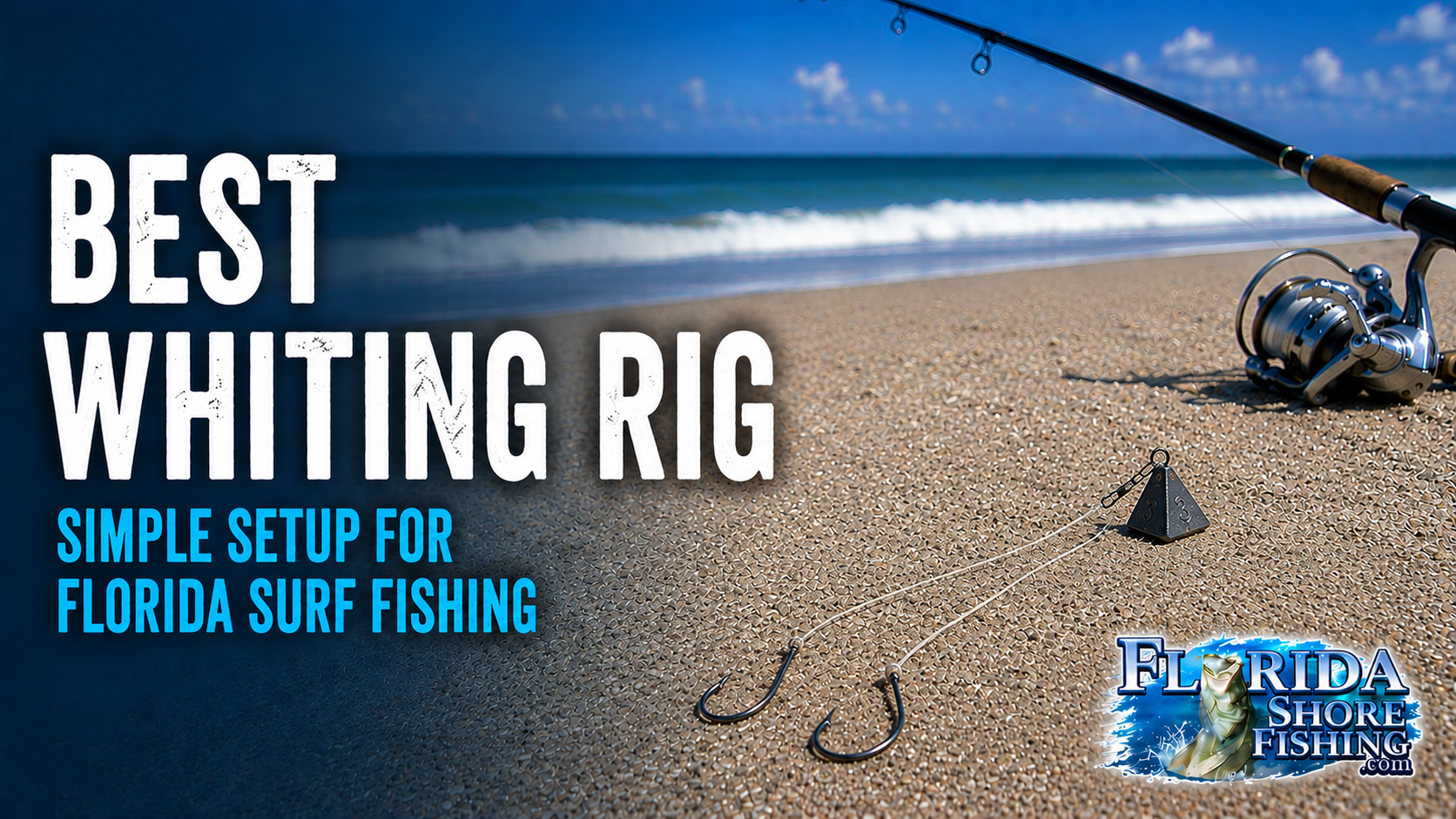
For most Florida beach fishing, the best whiting rig is a two-hook double-drop rig with small circle hooks and enough weight to hold the bottom. This is very similar to the rigs commonly used for pompano, which makes sense because whiting and pompano frequently feed in the same areas and eat many of the same natural baits.
The biggest difference is size. Whiting have relatively small mouths, so smaller hooks and smaller pieces of bait usually work better.
A good Florida whiting rig should accomplish three things:
- Keep your bait near the sandy bottom where whiting feed
- Present small pieces of bait that whiting can easily eat
- Use enough weight to hold your position without making the rig unnecessarily heavy
Get those things right, and there’s little reason to make your rig more complicated.
The Best All-Around Whiting Rig
For most Florida surf fishing situations, I recommend a two-hook double-drop rig.
The basic setup is:
Main line → swivel → leader → first dropper loop and hook → second dropper loop and hook → sinker
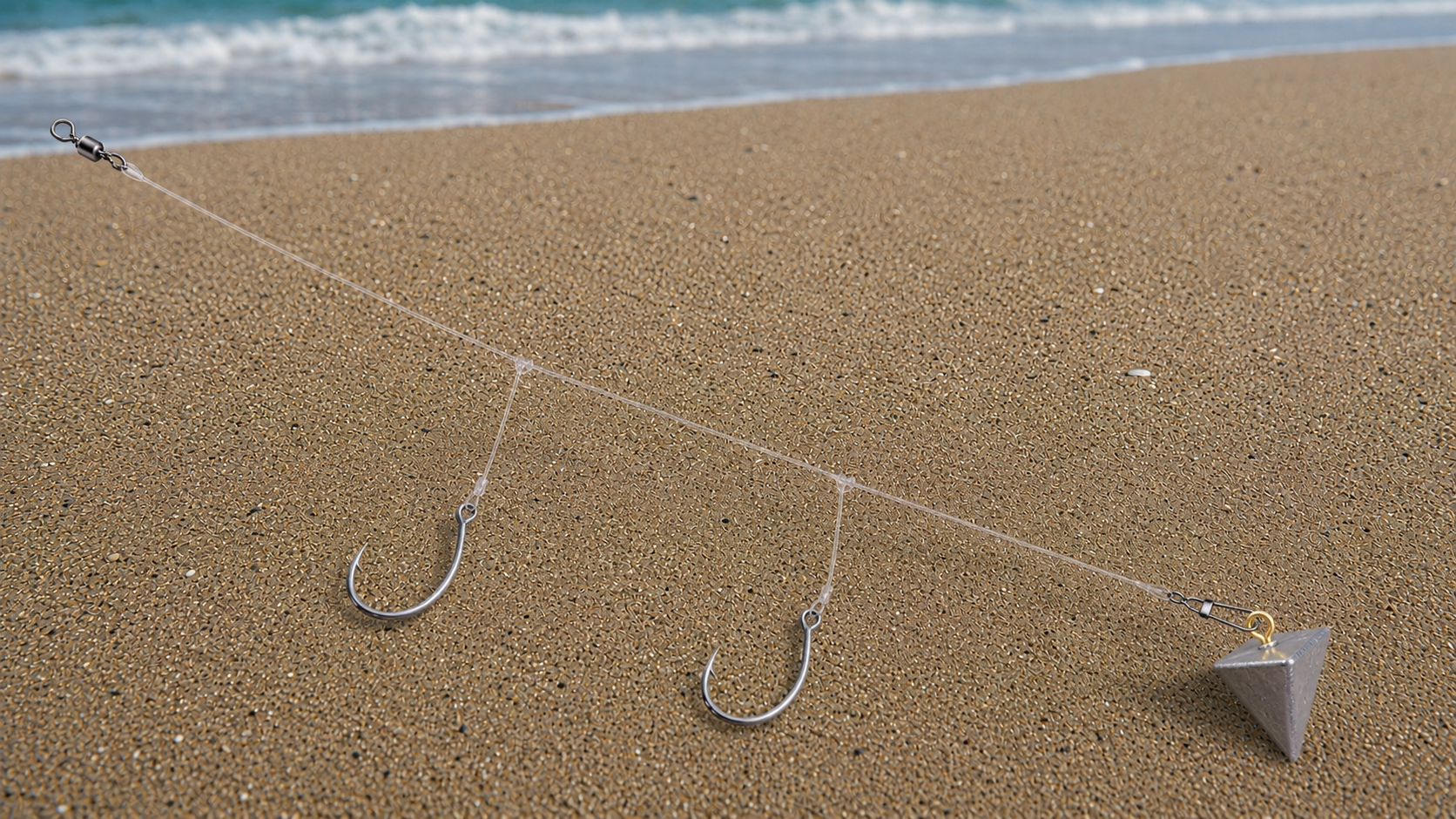
Here’s a good starting point:
| Component | Recommended Starting Point |
|---|---|
| Main Line | 10–20 lb braid or monofilament |
| Swivel | Small barrel swivel |
| Rig Leader | 15–25 lb monofilament or fluorocarbon |
| Hooks | #2 to #1 circle hooks |
| Number of Hooks | 2 |
| Sinker | 2–4 oz pyramid sinker |
| Bait | Small pieces of shrimp or sand fleas |
These aren’t absolute rules.
Florida surf conditions can change significantly from one day—or even one hour—to the next. Your sinker size, leader strength and even hook size can be adjusted to match the conditions and fish you’re encountering.
The basic idea remains the same.
Whiting spend much of their time feeding along sandy bottoms. A double-drop rig keeps two baits in the feeding zone while the sinker holds your presentation in place.
Using two hooks also gives you the opportunity to experiment with bait.
Put fresh shrimp on one hook and a sand flea on the other. If the whiting consistently choose one over the other, switch both hooks to the bait that’s producing.
Best Hook Size for Whiting
Using hooks that are too large is one of the easiest ways to miss whiting.
Whiting have relatively small mouths. While they may peck at a large bait on an oversized hook, that doesn’t mean they’ll actually get the hook into their mouth.
For typical Florida whiting, #2 to #1 circle hooks are a good starting point.
You can adjust slightly depending on the fish you’re catching and the size of your bait.
One important distinction for beginners: a #2 hook is much smaller than a 2/0 hook. Hook sizing can be confusing, and accidentally buying 2/0 hooks when you intended to buy #2 hooks gives you a considerably larger presentation.
Match the Hook to Your Bait
Your hook should also match the size of the bait you’re using.
If you’re fishing with a small piece of shrimp, you don’t need a giant hook buried inside it.
Thread enough shrimp onto the hook to keep it secure during the cast while leaving the hook point exposed.
Small hook. Small bait. Easy meal.
That’s a good formula for whiting.
Using Circle Hooks for Whiting
Circle hooks work very well for bottom fishing.
When using one, avoid making a dramatic hookset when you see the rod tip move.
Instead, begin reeling and steadily increase pressure. The shape of the circle hook helps it rotate toward the corner of the fish’s mouth as the line comes tight.
Best Leader for Whiting
Whiting aren’t usually found around the heavy structure that requires extremely heavy leader.
Most of the time you’re fishing over sand, so there’s little reason to build your whiting rig like you’re preparing to pull a grouper away from a wreck.
For most Florida surf fishing situations, 15- to 25-pound leader material is a reasonable starting point.
Monofilament is inexpensive and works very well for tying double-drop rigs.
Fluorocarbon is another option, particularly when the water is exceptionally clear and you want a lower-visibility presentation.
There’s usually no advantage to going unnecessarily heavy.
A very heavy leader can make the rig stiffer and more visible. Keep your tackle appropriate for the relatively small fish you’re targeting.
That said, remember that whiting aren’t the only fish roaming Florida beaches.
Pompano, redfish, black drum, bluefish and other species may eat the exact same bait. Using reasonably strong leader gives you a better chance of landing an unexpected larger fish.
Best Sinker for Whiting
Your sinker’s job is simple:
Keep the bait where you want it.
The best sinker isn’t necessarily the heaviest one you can cast. It’s the lightest sinker that reliably holds your rig in the fishing zone.
For typical Florida beach conditions, a 2- to 4-ounce pyramid sinker is a good place to start.
Pyramid sinkers work well in the surf because their shape helps them dig into the sand.
In calm conditions, you may be able to use less weight.
When the waves or current increase, you may need more.
When a Pyramid Sinker Won’t Hold
There will be days when even a reasonably heavy pyramid sinker won’t stay where you put it.
If your rig immediately starts washing down the beach, consider switching to a sinker designed to grip the sand more aggressively.
Sputnik-style sinkers and similar surf weights use legs or other features to increase their holding power.
They’re particularly useful when current is strong enough to roll ordinary sinkers.
Don’t Automatically Use a Heavy Sinker
More weight isn’t always better.
A heavier sinker requires heavier tackle to cast safely and can make your setup less sensitive.
Start with the lightest weight that will hold the bottom.
If your rig keeps moving too quickly, increase the weight or switch to a sinker with greater holding power.
Let the surf conditions determine the sinker rather than automatically reaching for the heaviest one in your tackle box.
One-Hook vs. Two-Hook Whiting Rig
Both setups catch whiting.
For general Florida surf fishing, however, I usually prefer a two-hook rig.
Advantages of a Two-Hook Whiting Rig
A double-drop rig gives you:
- Two baits in the water
- The ability to test two different baits
- Baits presented at slightly different positions
- The possibility of catching two fish at once
- Excellent compatibility with standard pompano fishing
It’s particularly useful when you first arrive at the beach and don’t know what the fish want.
You might put fresh shrimp on one hook and a sand flea on the other.
If one consistently gets bites, you’ve learned something useful.
Advantages of a One-Hook Rig
A single-hook rig is simpler and can be preferable when:
- Seaweed is collecting on your line
- The surf is rough
- You’re getting frequent tangles
- You’re fishing especially close to shore
- You’re using lighter tackle
- Fish are concentrated in a small area
There’s nothing wrong with simplifying your tackle.
If a single bait consistently catches fish, you don’t need a complicated rig just because it looks more impressive.
Pompano Rigs for Whiting
If you already fish Florida beaches for pompano, you may already own everything you need to catch whiting.
Pompano rigs can be excellent whiting rigs.
The two fisheries overlap considerably.
Pompano and whiting both feed along sandy beaches. Both eat shrimp and sand fleas, and both can be caught using double-drop bottom rigs.
The main adjustment I’d make when specifically targeting whiting is to downsize your presentation.
Some commercial pompano rigs use hooks that are larger than I’d choose specifically for whiting. They may also include floats, beads and other attractors.
Those rigs can certainly catch whiting.
However, if you’re getting lots of taps without actually hooking fish, check the size of your hooks and bait.
A relatively simple pompano-style rig equipped with #2 or #1 hooks can make an excellent Florida whiting rig.
Fish Finder Rig for Whiting
A double-drop rig isn’t the only way to catch whiting.
A fish finder rig, sometimes called a Carolina-style rig, can also be effective.
The basic setup consists of:
Main line → sliding sinker → bead → swivel → leader → hook
The sliding sinker allows the fish to pick up and move with the bait without immediately feeling the full resistance of the weight.
This can create a very natural presentation.
A fish finder rig is especially useful when you’re fishing a single bait in calmer water, around channels or inlets, or when you simply want a less complicated presentation.
For general beach fishing, I still prefer a double-drop rig because it allows you to fish two baits simultaneously.
But there are plenty of situations where a fish finder rig can catch whiting just as effectively.
How Far Should You Cast a Whiting Rig?
This is one of the most important things to understand about whiting fishing:
You don’t always need to cast far.
In fact, casting as far as possible can put your bait beyond the fish.
Whiting frequently feed in troughs running parallel to Florida beaches. Depending on the shape of the beach, that first trough may be surprisingly close to shore.
Breaking waves disturb the sand and expose worms, small crustaceans and other food.
Whiting take advantage of it.
That means the fish you’re trying to catch could be feeding much closer to your feet than you expect.
Start Close and Work Outward
Don’t make your longest possible cast automatically.
Cover different distances until you locate the fish.
If you’re fishing multiple rods, this becomes particularly easy.
Put one bait in the first trough.
Cast another farther out.
If you’re fishing a third rod, use it to investigate another distance or piece of beach structure.
Once one area starts consistently producing whiting, concentrate more of your effort there.
Learning to identify troughs, sandbars, cuts and other beach features is much more valuable than simply learning how to cast farther.
Our How to Read a Florida Beach guide goes deeper into finding these productive areas.
Best Bait for a Whiting Rig
For most situations, fresh shrimp is my first choice for whiting.
You don’t need an entire shrimp on each hook.
Cut it into small pieces that whiting can easily get into their mouths.
Other effective choices include:
- Sand fleas
- Frozen shrimp
- Scented artificial bait
- Clams
- Other small pieces of natural bait
Sand fleas are particularly worth trying when they’re naturally abundant along the beach.
You can also combine natural and artificial bait.
For example, put a small piece of shrimp on the hook along with a tiny strip of scented bait. The shrimp provides natural scent and flavor, while the more durable scented material may remain after smaller fish begin picking at the bait.
A two-hook rig also gives you an easy way to compare baits.
Fish shrimp on one hook and a sand flea or scented bait on the other.
Pay attention to which one the fish prefer.
For a complete breakdown, see our Best Bait for Whiting in Florida guide.
Common Whiting Rig Mistakes
A whiting rig is simple, but small mistakes can make a big difference.
Using Hooks That Are Too Large
If you’re getting repeated taps without hooking fish, your hooks may be too big.
Whiting have relatively small mouths.
Downsizing the hook is one of the first things I’d try.
Using Too Much Bait
A giant piece of shrimp isn’t necessarily more attractive to a whiting.
It can make it harder for the fish to take the hook and may cover the hook point.
Keep your bait small.
Using an Unnecessarily Heavy Leader
Most whiting fishing takes place over relatively clean sandy bottom.
You usually don’t need extremely heavy leader.
Keep your presentation appropriate for the fish you’re targeting while remembering that larger species may occasionally take your bait.
Using the Wrong Sinker Weight
If your rig is rapidly washing down the beach, the sinker isn’t doing its job.
Increase the weight or switch to a sinker with greater holding power.
But don’t go too far in the other direction.
If a 2-ounce pyramid holds the bottom perfectly, there’s little reason to use 5 ounces.
Casting Beyond the Fish
This is one of the biggest mistakes in surf fishing.
Long casts can be useful when the fish are far from shore.
They aren’t useful when the whiting are feeding in the first trough.
Don’t assume farther is better.
Burying the Hook Point
Keep your hook point exposed.
Your bait needs to attract the fish without interfering with the hook’s ability to do its job.
Fishing With Empty Hooks
Whiting aren’t the only creatures interested in shrimp.
Crabs, pinfish and other bait stealers can remove your bait without producing an obvious strike.
Check your rig periodically.
There’s no benefit to leaving a perfectly positioned rig in the water if both hooks are bare.
Keep Your Florida Whiting Rig Simple
You can make surf fishing rigs as complicated as you want.
Whiting don’t require it.
For most Florida beaches, start with a two-hook double-drop rig, #2 to #1 circle hooks, 15- to 25-pound leader and a 2- to 4-ounce pyramid sinker.
Add small pieces of fresh shrimp or sand fleas.
Then concentrate on the things that matter more than fancy tackle:
Where is the trough?
Where is the food?
Where are the fish feeding?
Start close to shore and work your way outward instead of automatically throwing your bait toward the horizon.
Adjust your sinker to match the surf.
Keep your hooks and baits small.
And when you begin catching whiting at a particular distance, pay attention. The fish are telling you something about the beach.
Ultimately, the best whiting rig for Florida surf fishing is the one that keeps a small, natural-looking bait in the feeding zone long enough for a whiting to find it.
For more information, continue with How to Catch Whiting, Best Bait for Whiting, Surf Fishing for Whiting, How to Read a Florida Beach, and our complete Florida Surf Fishing guide.
Daniel Hagan has been fishing Florida’s shores since 1985 and writing about it for more than 20 years. As Managing Editor of FloridaShoreFishing.com, he shares firsthand experience covering surf and pier fishing, tackle, techniques, and Florida’s coastal species.