
Last Updated on August 27, 2026
Every fall, one of Florida’s most exciting shore-fishing events begins along the Atlantic coast.
Thousands upon thousands of mullet gather into dense schools and begin moving through Florida’s coastal waters. Behind them come some of the state’s most sought-after predators: snook, tarpon, redfish, jack crevalle, sharks, Spanish mackerel, bluefish and more.
This is the Florida mullet run.
For shore anglers, it can produce some of the most spectacular fishing of the year. You might see mullet spraying from the surface as tarpon crash through a school, snook feeding in the wash only a few feet from dry sand, or jacks pushing bait against a jetty.
The best part is that you don’t need a boat to participate.
Beaches, piers, bridges, jetties and inlets can all put you directly in the path of migrating mullet and the predators following them.
The original Florida Shore Fishing guide described the run as beginning as temperatures fall from late summer into fall, with schools moving south and predators concentrating around them. That basic pattern remains the foundation of the fishery.
The challenge isn’t convincing fish to eat during the mullet run.
It’s figuring out where the bait is, where the predators are positioned around it, and how to make your bait stand out among thousands of real mullet.
Here’s how.
What Is the Florida Mullet Run?
The Florida mullet run is a seasonal migration associated with mullet gathering into large schools and moving out of estuarine and coastal habitats toward spawning areas.
Striped mullet (Mugil cephalus) are particularly important to this event.
These fish spend much of their lives in Florida’s estuaries, rivers, lagoons, canals, bays and coastal waters. As fall arrives, adult striped mullet form large schools and eventually migrate offshore to spawn. FWC describes adult striped mullet as migrating offshore in large schools for spawning, while the Florida Museum notes that spawning migrations occur during autumn and winter.
But anglers aren’t necessarily interested in catching the mullet themselves.
We’re interested in what follows them.
Mullet are an important prey species for many Florida gamefish. FWC specifically identifies species including redfish, snook, tarpon, speckled trout, billfish and sharks as predators of striped mullet.
Put thousands of those baitfish together in a relatively confined area and you’ve essentially created a moving buffet.
Predators know it.
So do Florida anglers.
When Is the Florida Mullet Run?
There isn’t a date you can circle on your calendar and confidently say:
“The mullet run starts today.”
It’s a natural migration, not a scheduled event.
Generally, anglers begin watching for increased mullet activity in late August and September, with the migration progressing through fall. Timing differs according to location and conditions.
FWC describes the spawning migration as occurring as temperatures drop during fall, when adult mullet leave freshwater and brackish environments, combine into increasingly large schools and migrate along the coast before eventually heading offshore.
The important thing for Florida shore anglers is that the run progresses geographically.
Mullet don’t simultaneously appear along every Florida beach.
Schools generally work south along the Atlantic coast, so northeast Florida can experience significant movement before anglers farther south see peak concentrations.
By September and October, the event can become especially important farther down Florida’s Atlantic coastline. South Florida’s prime activity often develops around late September into October, although conditions can shift the timing from year to year.
That variability is important.
Don’t plan your entire fishing season around one specific weekend because somebody told you that’s “mullet run weekend.”
Instead, watch what’s actually happening.
How to Know When the Mullet Run Has Reached Your Area
The easiest indicator is obvious:
Look for mullet.
Large schools can sometimes be visible from the beach as dark patches moving through the water.
You may also see individual fish jumping.
But predators can make the signs impossible to miss.
Watch for:
- Mullet repeatedly jumping
- Large dark schools moving parallel to shore
- Baitfish showering from the water
- Birds diving repeatedly
- Tarpon rolling or exploding through bait
- Sharks cutting through schools
- Jacks aggressively crashing the surface
- Snook feeding in the shore break
- Sudden bursts of activity along otherwise quiet water
Birds can be particularly useful.
If you’re walking onto the beach and notice a group of birds intensely working one section of water, investigate before setting up somewhere else.
The birds may be seeing bait you can’t see from ground level.
Also pay attention to fishing reports north of your location.
Because the Atlantic migration generally progresses southward, reports of major concentrations farther north can provide an early indication that increasing numbers of mullet may soon reach your area.
Best Places to Fish the Florida Mullet Run From Shore
One reason the mullet run is such a great event for Florida Shore Fishing readers is accessibility.
A huge amount of the action occurs within casting distance of land.
Some of the best places include:
- Beaches
- Inlets
- Jetties
- Piers
- Bridges
- Seawalls
- Intracoastal shorelines
Each offers different opportunities.
Fishing the Mullet Run From the Beach
The beach can provide some of the most visually exciting mullet-run fishing you’ll ever experience.
Schools may move directly along the shoreline.
Sometimes they’re far outside casting range.
Other times they’re practically at your feet.
This is why mobility matters.
Instead of arriving at the beach, planting four sand spikes and waiting six hours, consider traveling light enough that you can move.
If the bait is 300 yards down the beach, go to the bait.
Watch the First Trough
Don’t assume the action will be far offshore.
Snook and other predators can push mullet directly into the first trough or shore break.
A school traveling along the beach may suddenly become trapped between predators and shallow water.
That’s exactly the situation you’re looking for.
Look for Cuts and Sandbar Openings
Cuts through offshore sandbars naturally concentrate moving water.
They can also concentrate bait.
If a school of mullet approaches one of these areas, predators may use the structure and current to their advantage.
Watch Which Direction the School Is Moving
Don’t chase directly behind the bait if you can avoid it.
If you can determine the direction the school is traveling, move ahead of it.
Get into position.
Then wait.
It’s much easier to intercept a school than continually run behind one.
Fishing Florida Inlets During the Mullet Run
If I had to choose one type of location for experiencing the mullet run from shore, inlets would be near the top of the list.
Florida Shore Fishing’s original article emphasized inlets because they act as natural bottlenecks for moving bait.
That’s still exactly why they’re so productive.
An inlet connects two large bodies of water through a comparatively narrow opening.
Add tidal current and structure, and you have an ideal ambush area.
Mullet moving along the beach may encounter fish moving into or out of the inlet. Other schools may be traveling through the Intracoastal Waterway.
Predators can take advantage of all of it.
Look around:
- Jetty tips
- Current seams
- Rock edges
- Eddies
- Channel edges
- Beaches immediately beside the inlet
- Protected water behind structure
Pay particular attention to places where fast current meets slower water.
Predators often don’t want to spend unnecessary energy fighting the strongest current.
They can hold near the edge and attack bait carried past them.
Fishing Jetties During the Mullet Run
Jetties combine structure, current and access to deeper water.
That makes them natural predator habitat even before the mullet arrive.
Add thousands of migrating baitfish and things can get interesting quickly.
Fish may attack mullet:
- Along the rocks
- At the end of the jetty
- In current seams
- On the protected side
- Along the beach beside the jetty
The biggest challenge is landing them.
A good snook, tarpon, jack or shark can make short work of tackle that’s too light around rocks.
Match your equipment to both your target species and the structure you’re fishing.
Fishing Piers During the Mullet Run
A Florida fishing pier gives you an elevated view that can be incredibly useful.
Instead of trying to interpret the water from beach level, you may actually be able to watch schools approach.
Don’t immediately run to the end of the pier.
Mullet often travel close to the beach, and predators may follow them.
That means the productive water could be underneath the middle of the pier—or even close to shore.
Watch first.
Fish second.
If a school passes underneath you, pay attention to what’s happening around its perimeter and below it.
Fish the Edges of Mullet Schools
This may be the single most important mullet-run fishing tip.
Imagine you’re a snook.
There are 5,000 mullet swimming in front of you.
Now imagine an angler casts another perfectly healthy mullet directly into the middle.
Why would yours get eaten?
It’s surrounded by thousands of identical meals.
Instead, look at what predators naturally try to accomplish.
They attack schools, create confusion and isolate vulnerable individuals.
You want your bait to look like one of those vulnerable fish.
Fish the outside edge of the school.
The original FSF guide recommended exactly this approach: put your presentation around the outside rather than burying it among thousands of other mullet.
That can dramatically increase your bait’s visibility.
Look for:
- The front edge
- Back edge
- Outside edge
- Stragglers
- Smaller groups separated from the main school
- Injured bait
- Areas where predators are actively attacking
Think like a predator.
You’re looking for the easiest meal, not necessarily the largest concentration of food.
Best Live Bait for the Florida Mullet Run
This one isn’t complicated.
Mullet.
When predators are surrounded by mullet and actively eating mullet, a live mullet is one of the most natural presentations you can use.
Matching the dominant forage is a basic fishing principle, and during the mullet run the answer is swimming directly in front of you.
How Big Should the Mullet Be?
Match your bait reasonably closely to the mullet in the school.
If predators are feeding on finger mullet, start with finger mullet.
You don’t need an exact match, but throwing an enormous bait into a school of tiny mullet may not be your best first choice.
Observe the bait before selecting yours.
How to Rig Live Mullet
A free-lined mullet can be extremely effective when current and conditions allow it.
The setup can be remarkably simple:
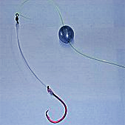
Main line → leader → hook → mullet
That’s it.
The lack of weight allows the bait to swim naturally.
Mullet naturally spend considerable time near the surface, so eliminating unnecessary weight can allow the bait to swim more freely and create a more natural presentation.
However, free-lining isn’t always practical.
Strong current can carry your bait somewhere you don’t want it.
Sometimes predators are underneath the school.
Sometimes you need to get your bait deeper.
In those situations, add enough weight to control the presentation.
The rule is simple:
Don’t add weight because you think a fishing rig is supposed to have a sinker. Add weight because conditions require it.
What If You Can’t Reach the Edge of the School?
This happens frequently from fixed structures.
Imagine you’re standing on a pier.
A gigantic school surrounds the entire structure.
You physically can’t cast outside it.
Now what?
Go underneath.
Predators don’t always attack horizontally from the sides.
Some position themselves below the bait.
Adding enough weight to drop your bait underneath the school can present it to predators waiting below.
This can also produce surprise catches.
Flounder, for example, may remain near the bottom beneath concentrations of baitfish. The original FSF article specifically recommended slowly working bottom presentations beneath large schools for this reason.
Best Lures for the Florida Mullet Run
Live bait isn’t required.
Artificial lures can be extremely productive because predators are already primed to attack baitfish-shaped objects.
Good choices include:
Paddle Tails
A 4- to 6-inch paddle tail is an excellent general-purpose mullet imitation.
Choose a jighead appropriate for the water depth and current.
You can retrieve it steadily, work it erratically or let it sink beneath a school.
Topwater Plugs
Few things are more exciting than a big fish exploding on a topwater lure during the mullet run.
Topwaters can be particularly useful when predators are actively attacking bait near the surface.
Walk-the-dog style plugs imitate an injured or disoriented baitfish extremely well.
Hard-Bodied Mullet Imitations
Suspending and swimming plugs can also be excellent.
Again, try to roughly match the size of the available forage.
Spoons
Spoons provide casting distance, flash and durability.
That last characteristic matters.
A lot.
Use Tough Lures
The Florida mullet run can be brutal on fishing tackle.
You’re not necessarily going to catch only the species you intended to target.
Your lure could encounter:
- Snook
- Tarpon
- Jack crevalle
- Bluefish
- Spanish mackerel
- Sharks
- Barracuda
Some have serious teeth.
Others are simply powerful enough to destroy cheap hardware.
Inspect:
- Split rings
- Hooks
- Leaders
- Knots
- Lure bodies
Check everything after a hard strike or landed fish.
A slightly damaged leader may look fine until the next tarpon grabs your lure.
How to Work Lures Around a Mullet School
Don’t mindlessly throw directly into the center.
Use the same strategy as live bait.
Work the perimeter.
Cast ahead of the school and retrieve across its path.
Cast beyond an outside edge and bring the lure toward it.
If predators are visibly attacking one particular side, concentrate there.
Try to make your lure look different from the thousands of healthy mullet around it.
An injured mullet might:
- Fall behind
- Swim erratically
- Separate from the school
- Pause
- Drop deeper
- Struggle near the surface
Your lure can imitate those vulnerabilities.
If a steady retrieve isn’t working, change it.
Speed up.
Slow down.
Pause.
Twitch.
Let the lure fall.
You’re trying to trigger the predator’s instinct to attack the easiest target.
Best Fish to Catch During the Florida Mullet Run
The species available depend heavily on where you’re fishing, but the diversity is part of what makes the run special.
Snook
Snook and mullet are a classic Florida combination.
Look for snook around beaches, inlets, bridges, seawalls and other ambush points.
Don’t overlook extremely shallow water.
A large snook can feed surprisingly close to dry sand when mullet are pushed against the beach.
Tarpon
Seeing tarpon crash through a school of mullet is something every Florida angler should experience.
They may roll quietly one minute and erupt violently the next.
If you’re specifically targeting them, make sure your tackle is appropriate for both the fish and fishing location.
Redfish
Redfish also take advantage of the seasonal abundance.
Look around inlets, beaches, channels, oyster areas and other productive inshore structure.
Jack Crevalle
Jacks can turn a calm school of mullet into complete chaos.
They hit hard, fight even harder and aren’t particularly subtle about feeding.
If you see water exploding as predators slash through bait, jacks are one possible culprit.
Sharks
Where there are huge numbers of baitfish, sharks won’t be far behind.
Shore anglers may encounter multiple species depending on location.
Spanish Mackerel and Bluefish
Both can tear through schools of baitfish and readily attack fast-moving artificial lures.
Their teeth also explain why you should inspect your leader frequently.
Flounder
While everyone is staring at the surface, don’t forget the bottom.
A flounder doesn’t need to join the chaos above.
It can simply wait underneath for an easy meal to come within range.
Don’t Leave Fish to Find Fish
The mullet run encourages anglers to chase action.
That’s part of the fun.
But don’t become so obsessed with finding the biggest school that you abandon productive water.
If you’re getting bites, stay with them.
A relatively small group of mullet surrounded by actively feeding predators can be much better than a gigantic school with little predator activity.
Remember:
Mullet aren’t what you’re really searching for. You’re searching for predators feeding on mullet.
There’s a difference.
Don’t Assume Every Mullet School Holds Feeding Fish
This is another important lesson.
You can find a massive school and see almost no predatory activity.
That doesn’t necessarily mean predators aren’t present, but don’t automatically assume thousands of mullet guarantee instant hookups.
Fish the perimeter.
Try beneath the school.
Experiment with live bait and lures.
Watch carefully.
If nothing happens and another active school is nearby, move.
The run is dynamic.
A quiet school can explode five minutes later—or continue swimming peacefully down the coast.
Mullet Run Tackle for Shore Anglers
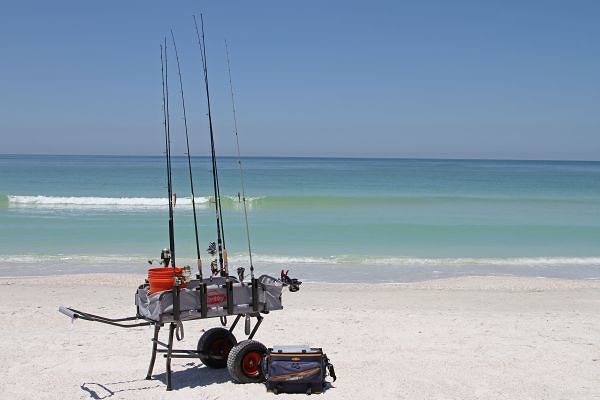
There’s no single perfect setup because catching a 4-pound jack from an open beach is very different from trying to stop a big snook beside jetty rocks.
For general shore fishing, you want tackle that gives you:
- Good casting distance
- Enough backbone for larger fish
- Adequate line capacity
- Reliable drag
- Leader strength appropriate for the target
- Strong hooks and terminal tackle
If you’re around rocks, pilings or other heavy structure, consider stepping up your tackle.
The fish may only need a few seconds to reach cover.
On an open beach, you have more room to let a fish run.
Match your equipment to the situation rather than simply fishing the heaviest tackle possible.
Mullet Run Fishing From the Atlantic Coast vs. Gulf Coast
The famous Florida fall mullet run is most closely associated with the Atlantic side and the dramatic southward movement of bait along the east coast.
However, mullet are found throughout Florida.
Florida’s Department of Agriculture notes that mullet occur in bays and estuaries along both coasts, and large schools move from shallow coastal waters toward deeper spawning areas during late fall.
So Gulf Coast anglers certainly experience seasonal mullet movements and excellent predator fishing.
But if you’re specifically talking about the iconic spectacle of giant schools moving down beaches while tarpon, snook, jacks and sharks attack them, Florida’s Atlantic coast is the centerpiece of the traditional fall mullet-run fishery.
A Simple Mullet Run Game Plan
If you’re heading out specifically to fish the run, don’t make things unnecessarily complicated.
1. Find the bait.
Look for jumping mullet, dark schools, birds and surface activity.
2. Determine which direction they’re moving.
Try to get ahead of them instead of chasing from behind.
3. Look for predators.
Exploding bait, rolling tarpon and sudden surface disturbances are obvious signs.
4. Fish the edge.
Don’t bury your bait or lure among thousands of mullet unless you have no alternative.
5. Match the forage.
Use live mullet or artificial lures with a similar profile.
6. Change depth if necessary.
If nothing attacks near the surface, fish beneath the school.
7. Stay mobile.
The fish are moving. You may need to move too.
8. Inspect your tackle.
Powerful fish and toothy predators can damage leaders, hooks and lures.
9. Don’t abandon active fish.
A smaller school producing strikes is better than a giant school doing nothing.
10. Be ready for anything.
That’s half the fun.
Florida Mullet Regulations
Always check the FWC Mullet Regulations to be up to date.
Why the Florida Mullet Run Is Worth Fishing
Florida has excellent shore fishing throughout the year.
But the mullet run is different.
It’s visual.
You aren’t simply casting into water and hoping something happens.
You can watch the entire food chain unfold in front of you.
A dark patch appears down the beach.
The patch gets closer.
Individual mullet begin jumping.
Birds arrive.
Suddenly the surface erupts.
Mullet scatter in every direction while something much larger crashes through the middle.
Your next cast might produce a snook.
Or a jack.
Or a tarpon.
Or a shark.
Sometimes nothing happens at all.
Then 20 minutes later the ocean comes alive again.
That’s the Florida mullet run.
For shore anglers, the basic strategy is remarkably simple:
Find the mullet. Find the predators. Fish the edges.
Don’t worry about making the longest cast on the beach. Don’t automatically throw your bait into the densest portion of the school. And don’t stay anchored to one location when the entire fishery is moving past you.
Follow the bait, watch what the predators are doing and adjust your presentation accordingly.
When everything comes together, the Florida fall mullet run can deliver some of the most exciting fishing you’ll experience from shore all year.
Daniel Hagan has been fishing Florida’s shores since 1985 and writing about it for more than 20 years. As Managing Editor of FloridaShoreFishing.com, he shares firsthand experience covering surf and pier fishing, tackle, techniques, and Florida’s coastal species.