
Last Updated on September 21, 2026
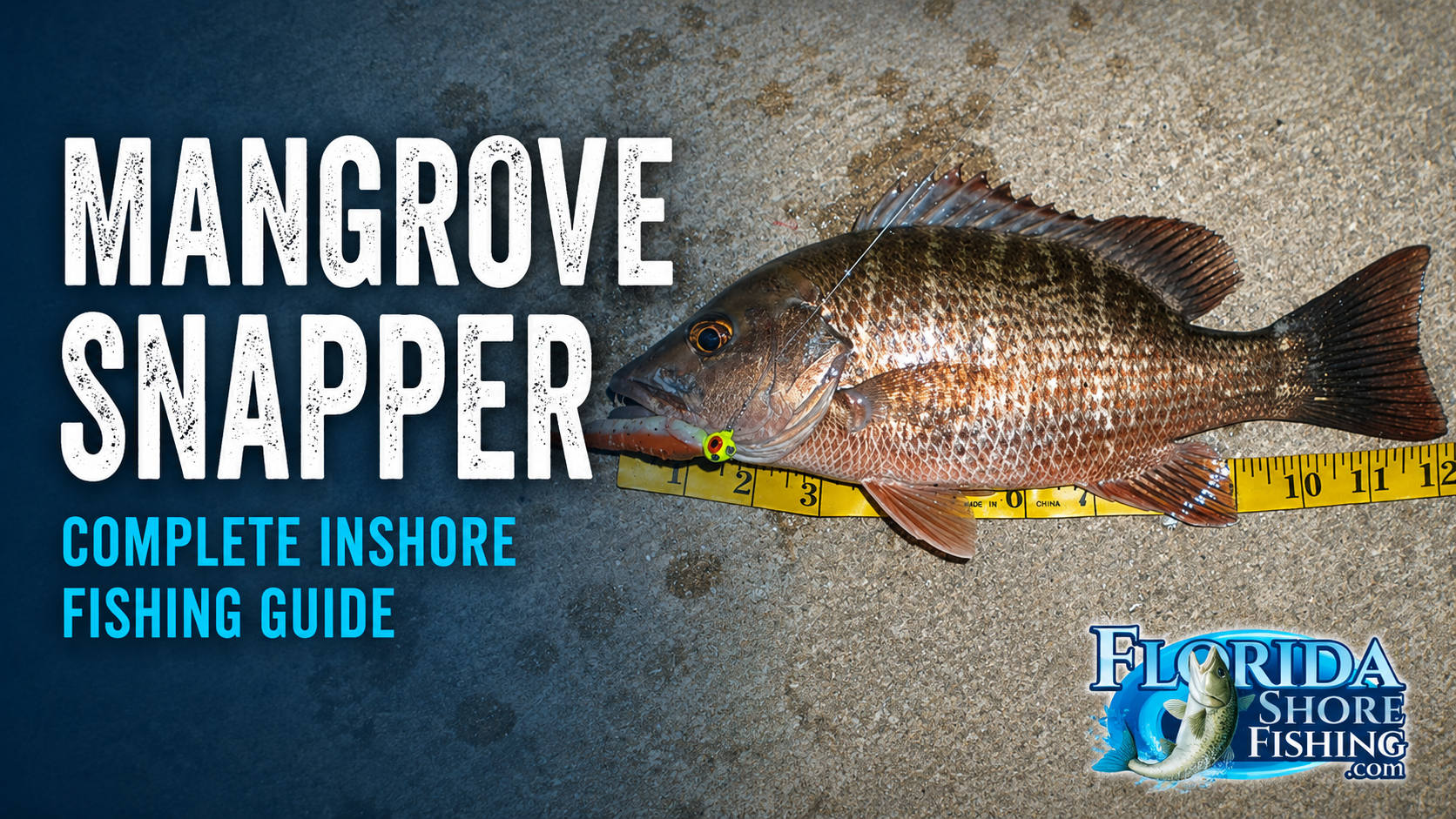
Mangrove Snapper are one of the best fish for Florida shore anglers to target. They are widely distributed, aggressive when feeding, excellent on the dinner table, and—unlike many other snapper species—you don’t need an offshore boat to catch them.
You can find Mangrove Snapper around bridges, piers, docks, mangrove shorelines, inlets, rock piles, oyster bars, seawalls, and other structure throughout much of Florida.
They’re also a fish that rewards anglers who pay attention to the details.
Mangrove Snapper have excellent eyesight, spend much of their time close to structure, and have a habit of grabbing a bait and immediately heading for cover. The difference between getting bites and actually landing fish can come down to leader size, bait presentation, current, hook size, and where you place your cast.
This complete guide covers the fundamentals of finding and catching Mangrove Snapper from Florida’s shores, including where to find them, the best baits and tackle, productive rigs, and techniques for fishing around structure.
Mangrove Snapper Quick Guide
| Category | Recommendation |
|---|---|
| Best Locations | Bridges, piers, docks, mangroves, inlets and rock structure |
| Best Natural Baits | Mud minnows, live shrimp, small baitfish and small crabs |
| Best Artificial Baits | Small scented shrimp, soft plastics and small swimbaits |
| Rod | Medium-light to medium spinning rod |
| Reel | 2500–3000 size spinning reel |
| Main Line | 10–20 lb braid |
| Leader | 12–20 lb fluorocarbon |
| Popular Rigs | Knocker rig and fish finder/Carolina rig |
| Key Strategy | Fish close to structure and use the current |
| Difficulty | Beginner to intermediate |
Light inshore tackle and fluorocarbon leaders are a good starting point. Mangrove Snapper are highly structure-oriented, so you need enough power to control a hooked fish without making your presentation unnecessarily heavy.
What Is a Mangrove Snapper?
Mangrove Snapper (Lutjanus griseus) are also commonly called Gray Snapper, and some Florida anglers simply call them “mangos.”
They’re one of the snapper species most accessible to Florida inshore and shore anglers.
Mangrove Snapper are coastal fish strongly associated with structure and habitats such as reefs, mangroves, seagrass beds, docks, bridges and rocky areas. Their diet includes crustaceans and small fish.
Young Mangrove Snapper spend much of their lives in protected coastal habitats. As they grow, larger individuals increasingly utilize deeper and offshore structure.
That’s good news for Florida shore fishermen.
The smaller fish aren’t simply occasional visitors to inshore water. Florida’s estuaries and structure provide exactly the type of habitat juvenile Mangrove Snapper need.
How to Identify Mangrove Snapper
Mangrove Snapper can vary considerably in appearance.
Depending on the water, habitat, and individual fish, their coloration may range from gray and brown to bronze or olive, sometimes with reddish or orange coloration along the sides.
Look for several important characteristics:
- A streamlined snapper-shaped body
- Two prominent canine teeth near the front of the upper jaw
- Dark or reddish borders along the dorsal fins
- Gray, brown, bronze, or olive coloration
- Reddish-orange spotting or coloration along the sides
- A dark stripe running from the snout through the eye on younger fish
Mangrove Snapper can sometimes be confused with Cubera Snapper and Schoolmaster, making proper identification important.
For a closer look at identification, biology, habitat, size and similar species, see our Mangrove Snapper Fish Profile.
Where to Find Mangrove Snapper in Florida
If you remember only one thing about locating Mangrove Snapper, remember this:
Find structure.
Mangrove Snapper are strongly associated with cover.
Piers, bridges, rock piles, wrecks, mangrove overhangs, docks and other hard structure can all provide productive inshore habitat.
For a more detailed look at the types of structure to target, see our guide to the Best Locations for Mangrove Snapper From Shore.
Bridges
Florida bridges can provide almost everything Mangrove Snapper want.
Pilings provide cover. Barnacles and other organisms create an ecosystem around the structure. Current carries food past the fish, and deeper channels underneath many bridges give snapper access to different depths.
Don’t automatically cast as far away from the bridge as possible.
The fish you’re trying to catch may be directly underneath you.
Piers
Piers are another excellent option.
Concentrate on pilings, cross-members and other submerged structure rather than randomly casting into open water.
A pier near deeper water or strong tidal movement can be particularly productive.
Docks
Residential and public docks provide shade and cover while attracting baitfish, shrimp, crabs and other food.
Mangrove Snapper may hold surprisingly tight to dock pilings.
Accuracy becomes more important than casting distance.
Mangrove Shorelines
The fish didn’t get their common name by accident.
Mangrove roots create complicated underwater structure that provides both food and protection for juvenile fish.
Present a bait near submerged roots without putting it so deep into the cover that every hooked fish immediately breaks you off.
Inlets and Passes
Florida’s inlets combine structure, current, bait and deeper water.
Look around rocks, bridge pilings, seawalls, jetties, channel edges and current breaks.
Rock Piles and Seawalls
Hard structure doesn’t need to be enormous.
A relatively small rock pile surrounded by otherwise featureless bottom can concentrate fish.
The same applies to seawalls, particularly when deeper water or current is nearby.
Oyster Bars and Shell Bottom
Oyster-covered structure creates feeding opportunities and hiding places, but it also creates one major problem for anglers:
Abrasion.
Once a Mangrove Snapper gets your leader into oysters or barnacle-covered structure, the fight can end very quickly.
Current Is One of the Keys to Finding Mangrove Snapper
Finding structure is only half the equation.
The next question should be:
What is the current doing?
Mangrove Snapper are ambush predators. Structure allows them to hold in an advantageous position while moving water delivers potential food.
Look for places where structure changes the current.
- Eddies behind pilings
- Current seams
- Protected pockets
- Scoured holes
- Channel edges
- Points where current changes direction
- Areas immediately adjacent to strong flow
A bait presented naturally through one of these feeding areas is usually much more effective than a bait simply sitting somewhere nearby.
Do Mangrove Snapper Stay on the Bottom?
Not always.
Mangrove Snapper are commonly associated with the lower part of the water column, but they can suspend above the bottom and throughout the water column when actively feeding.
If you’re confident fish are around but your bottom presentation isn’t producing, experiment with depth.
The snapper may be several feet above your bait.
This is particularly worth remembering around deep bridge pilings, docks and piers.
Best Time to Catch Mangrove Snapper
Mangrove Snapper can be caught throughout the year in Florida, but location and behavior change with conditions.
Inshore fishing can be especially productive during warmer periods, while cooler conditions may push some fish toward deeper water.
Tidal movement can be even more important than the time displayed on your watch.
Moving water creates feeding opportunities around structure.
Instead of thinking only in terms of “morning” or “afternoon,” learn how the tide affects the location you’re fishing.
A bridge that seems lifeless at slack water can become completely different once the current begins moving.
Best Bait for Mangrove Snapper
If your goal is to catch Mangrove Snapper consistently, natural bait is an excellent starting point.
Mangrove Snapper naturally eat crustaceans and small fish.
My preferred baits are:
- Mud minnows
- Live shrimp
- Pilchards / Greenbacks
- Small pinfish
- Finger mullet
- Fresh cut bait
- Small crabs
For a detailed comparison of each bait and when to use it, see our complete Best Baits for Mangrove Snapper From Shore guide.
Mud Minnows
Mud minnows are my favorite bait when specifically targeting inshore Mangrove Snapper.
They’re extremely hardy, stay lively on the hook, and naturally occur around many of the same bridges, docks, mangroves and other inshore structure where snapper feed.
In my experience, mud minnows will often outfish live shrimp for Mangrove Snapper while also avoiding much of the nuisance bycatch that constantly picks at shrimp.
Live Shrimp
Live shrimp are probably the most popular bait for inshore Mangrove Snapper, and for good reason.
They’re readily available, easy to fish and Mangrove Snapper readily eat them. Shrimp can be especially effective when snapper are picky or ignoring larger baitfish.
The downside is that almost everything eats shrimp, so expect more bait stealing and unwanted bycatch.
Pilchards, Pinfish and Finger Mullet
Small live baitfish are another excellent option.
Pilchards or greenbacks, small pinfish and finger mullet all produce Mangrove Snapper, particularly when they match the baitfish naturally present where you’re fishing.
Keep them relatively small. You’re trying to imitate the prey inshore snapper are already feeding on, not offer the biggest bait possible.
Fresh Cut Bait
Small pieces of fresh pilchard, mullet, pinfish or other local baitfish can also catch Mangrove Snapper.
Fresh cut bait releases scent into moving water, helping snapper locate your presentation around structure.
Use small pieces rather than large chunks and leave the hook point exposed.
Small Crabs
Small crabs are an underrated Mangrove Snapper bait, particularly around bridges, rocks, oyster-covered structure and mangrove shorelines.
Mud crabs and other appropriately sized crabs resemble prey snapper naturally encounter in these areas. Keep the presentation small and natural, especially when targeting typical inshore fish.
Best Artificial Lures for Mangrove Snapper
Mangrove Snapper aren’t limited to natural bait.
They can also be caught on artificial lures, particularly when they’re actively feeding.
Productive choices include:
- Small scented shrimp
- 2- to 3-inch paddle tails
- Small curl-tail grubs
- Shrimp imitations
- Small jerkbaits
- Mud minnow imitations
- Small baitfish profiles
The key is downsizing.
A small jig head paired with a soft plastic is one of the simplest approaches.
Use only enough weight to control the lure.
Cast past or slightly up-current of the structure and work the lure through the strike zone.
Be ready. A snapper may hit the lure and immediately turn toward the structure.
Best Rod and Reel for Mangrove Snapper
You don’t need offshore snapper equipment to catch inshore Mangrove Snapper.
For most Florida shore situations, a good starting setup is:
Rod: 7-foot medium-light or medium spinning rod
Reel: 2500–3000 spinning reel
Main line: 10–20 lb braided line
Leader: 12–20 lb fluorocarbon
The exact setup should depend on the structure.
Open water beside a pier may allow you to fish relatively light. Barnacle-covered bridge pilings are another story.
You need enough power to stop the fish before it reaches something capable of cutting your leader.
For rod power, reel size, braid, leader, hooks, sinkers and rig recommendations, see our Best Gear for Mangrove Snapper From Shore guide.
Why Fluorocarbon Leader Matters
Mangrove Snapper can be frustratingly leader-sensitive.
Clear water can make this worse.
Fluorocarbon gives you a relatively low-visibility presentation while also providing valuable abrasion resistance around rocks, pilings, oysters and docks.
But don’t automatically reach for extremely heavy leader because you’re fishing structure.
Heavy leader may survive abrasion better, but it can also reduce bites.
Use the lightest leader that gives you a realistic chance of landing the fish around the structure you’re fishing.
If you’re getting broken off repeatedly, go heavier.
If you’re not getting bites in clear water, consider going lighter.
Best Hooks for Mangrove Snapper
Small hooks are usually better than oversized hooks for inshore Mangrove Snapper.
The exact hook depends on your bait, but 1/0 to 2/0 circle hooks are a useful starting range for many live-bait presentations.
Match the hook to the bait rather than selecting it based solely on the fish.
A small live shrimp shouldn’t be overwhelmed by a huge hook. Likewise, a larger baitfish may require something stronger.
Keep the hook point exposed and allow the bait to move naturally.
Best Rigs for Mangrove Snapper
You don’t need an elaborate rig.
Two simple setups cover a large percentage of Florida inshore situations.
Fish Finder Rig
The fish finder rig, often called a Carolina rig, is one of the most versatile.
A basic version consists of:
- Main line
- Sliding egg sinker
- Bead
- Barrel swivel
- 12–20 inches of fluorocarbon leader
- Circle hook
The sinker should be just heavy enough to control the presentation.
Too much weight makes the rig less natural.
Knocker Rig
The knocker rig is particularly useful around structure.
Instead of stopping above a swivel, the egg sinker slides down until it reaches the hook.
It’s compact, simple and excellent for getting a bait down near bridges, docks, rocks and pilings.
How to Catch Mangrove Snapper From Shore
Once you’ve found productive structure, resist the temptation to simply throw your bait into the deepest water you can reach.
Look at the structure and current first.
Position yourself so the bait can approach the fish naturally.
When possible, cast slightly up-current and allow the water to carry the bait toward the structure.
This makes your bait behave more like natural prey while allowing you to cover water rather than leaving the bait motionless in one location.
Pay close attention as your bait enters the area immediately around the structure.
That’s often where the bite happens.
How to Catch Mangrove Snapper From Bridges
Bridges deserve special attention because they’re one of Florida’s best shore-accessible snapper habitats.
Look for:
- Pilings
- Shadow lines
- Current breaks
- Deep channels
- Rock around bridge bases
- Eddies
- Areas where bait accumulates
Try dropping a bait alongside a piling or allowing it to sweep naturally toward one.
You often don’t need a long cast.
The challenge is what happens after the bite. A bridge snapper may have only a few feet to travel before reaching barnacles, concrete or other line-cutting structure.
Keep the rod ready and apply pressure quickly.
How to Catch Mangrove Snapper From Piers
Piers work on the same basic principle.
Fish the structure, not just the water around it.
Pilings create cover and alter current. They also support marine life that attracts bait.
Fish different depths until you establish a pattern.
If everyone is fishing the bottom and getting no bites, try presenting a shrimp or small baitfish higher in the water column.
Also pay attention to where other anglers are hooking fish. A pattern may develop around one particular set of pilings or one side of the pier because of current direction.
How to Catch Mangrove Snapper Around Mangroves
Fishing actual mangrove shorelines requires accuracy.
You want your bait close enough to the roots to reach the fish without placing it somewhere you have virtually no chance of landing one.
Cast parallel to mangrove edges when possible.
Look for:
- Points
- Small openings
- Deeper pockets
- Creek mouths
- Undercut shorelines
- Current sweeping past roots
A live shrimp or mud minnow presented naturally along these edges can be extremely effective.
These are exactly the types of features covered in more detail in our Mangrove Snapper Locations Guide.
How Mangrove Snapper Bite
The bite can vary dramatically.
Sometimes you’ll get a hard strike followed by an immediate run toward cover.
Other times, especially with pressured fish, you’ll feel subtle taps.
Your response depends partly on the hook.
With a conventional J-hook, you’ll generally need to set the hook.
With a circle hook, don’t make a hard hookset.
Begin reeling and smoothly increase pressure. The hook is designed to rotate into the corner of the fish’s mouth as the line tightens.
Getting Mangrove Snapper Away From Structure
Hooking one is only half the job.
The first few seconds of the fight are often the most important.
A Mangrove Snapper doesn’t need to make a 100-yard run to beat you.
It may need only three feet.
If that three feet puts your line against a barnacle-covered piling, oyster shell, rock or mangrove root, the fight may be over.
Once hooked:
- Keep steady pressure on the fish.
- Get it moving away from structure immediately.
- Don’t give unnecessary slack.
- Use the rod to change the fish’s direction.
Once you’ve pulled it into relatively open water, you can relax slightly and enjoy the fight.
If break-offs are a constant problem, the Mangrove Snapper Gear Guide explains when to increase braid and leader strength for heavy bridge, piling and rock structure.
What to Do When Mangrove Snapper Won’t Bite
Mangrove Snapper can go from aggressive to incredibly frustrating.
If you know fish are present but aren’t getting bites, change the presentation before abandoning the location.
Try:
- A smaller hook
- Lighter fluorocarbon
- A longer leader
- Less sinker weight
- A smaller bait
- Fresh bait
- A different depth
- Casting farther from the structure and drifting toward it
- Switching from baitfish to shrimp
- Switching from natural bait to a small scented lure
Downsizing hooks and weight or lengthening the fluorocarbon leader can improve your presentation when fish become cautious.
Don’t change everything simultaneously.
Change one variable and see whether the fish respond.
Common Mangrove Snapper Fishing Mistakes
Fishing Too Far From Structure
Mangrove Snapper like cover.
Casting into empty water because it’s easier isn’t necessarily going to catch more fish.
Using Too Much Weight
You need enough weight to control the bait—not enough to anchor a small boat.
Let the bait move naturally whenever conditions allow.
Using Leader That’s Too Heavy
Structure tempts anglers to use extremely heavy leader.
Sometimes that’s necessary.
But in clear water, heavy leader can reduce bites.
Using Oversized Baits and Hooks
Inshore Mangrove Snapper aren’t giant fish.
Match your tackle to the fish you’re actually targeting.
Ignoring the Current
A great piece of structure can fish poorly from the wrong angle.
Think about where the current is carrying food.
Giving the Fish Too Much Line
Around heavy structure, hesitation can cost you.
Once the fish is hooked, start controlling it.
Mangrove Snapper Fishing Strategy for Beginners
If you’re completely new to targeting Mangrove Snapper, don’t overcomplicate it.
Start with this:
Find a public pier, bridge, dock, inlet or shoreline with obvious structure.
Use a medium spinning rod with braided line and fluorocarbon leader.
Rig a small live shrimp or mud minnow on a simple knocker or fish finder rig.
Use only enough weight to control your bait.
Find moving water.
Present the bait close to structure.
When a fish eats, get it away from cover.
That’s enough to start catching Mangrove Snapper.
As you gain experience, you can refine leader size, bait selection, hook size, current positioning and presentation.
Mangrove Snapper Fishing FAQ
What is the best bait for Mangrove Snapper?
Mud minnows and live shrimp are two excellent choices for inshore Mangrove Snapper. Small finger mullet, pinfish, pilchards, crabs and fresh cut bait can also work well.
When specifically targeting Mangrove Snapper, mud minnows are my first choice because they’re hardy, stay lively on the hook and tend to avoid some of the nuisance bycatch that comes with shrimp. You can compare all seven options in our Mangrove Snapper Bait Guide.
What is the best rig for Mangrove Snapper?
A knocker rig or fish finder rig will cover most situations. Use the fish finder rig when you want more natural bait movement and the knocker rig when you need a simple, compact presentation around structure.
What size hook should I use for Mangrove Snapper?
For typical inshore fish, a 1/0 or 2/0 circle hook is a useful starting point. Adjust according to the size of your bait and the fish you’re encountering.
Do Mangrove Snapper bite artificial lures?
Yes. Small scented shrimp, paddle tails, grubs and other compact soft plastics can catch Mangrove Snapper. Keep the lure relatively small and work it close to structure.
Can you catch Mangrove Snapper from shore?
Absolutely. Bridges, piers, docks, inlets, mangrove shorelines, seawalls and rock structure can all put shore anglers within reach of Mangrove Snapper.
Do Mangrove Snapper stay on the bottom?
Not necessarily. Although they’re strongly associated with structure and often feed near the bottom, Mangrove Snapper can suspend throughout the water column.
Is incoming or outgoing tide better for Mangrove Snapper?
Either can produce fish. Moving water is usually more important than simply choosing incoming versus outgoing. Learn how each tide interacts with the particular structure you’re fishing.
Why do I keep losing Mangrove Snapper?
Structure is probably the answer.
Snapper frequently head directly toward pilings, rocks, oysters, roots and other cover after being hooked. Use appropriate leader, keep steady pressure on the fish, and try to turn it before it reaches abrasive structure.
Build Your Mangrove Snapper Fishing Strategy
Mangrove Snapper are almost perfectly suited to Florida shore fishing.
They’re widespread, structure-oriented, willing to eat a variety of baits, fun on light tackle, and available from places anglers can reach without a boat.
The formula isn’t complicated:
Find structure. Find moving water. Use appropriately light tackle. Present a small bait naturally. Be ready to pull the fish away from cover.
Once you understand those fundamentals, Mangrove Snapper become much easier to target consistently.
Florida Shore Fishing Mangrove Snapper Resources
Explore our complete collection of Mangrove Snapper resources for identification, bait, gear, locations, and proven shore-fishing techniques.
Comment here
You must be logged in to post a comment.